
French Fries
Connie Liu: Inprogress.works

Dear reader,
»Did you write that I like french fries?« asked Uno when we started to talk about this newsletter during yesterday’s dinner.
»No, should I?«
»Yes. You should write everything I like.«
With care,
Kristoffer
⊹ ࣪ ﹏𓊝﹏𓂁﹏⊹ ࣪ ˖
Connie Liu: Inprogress.works
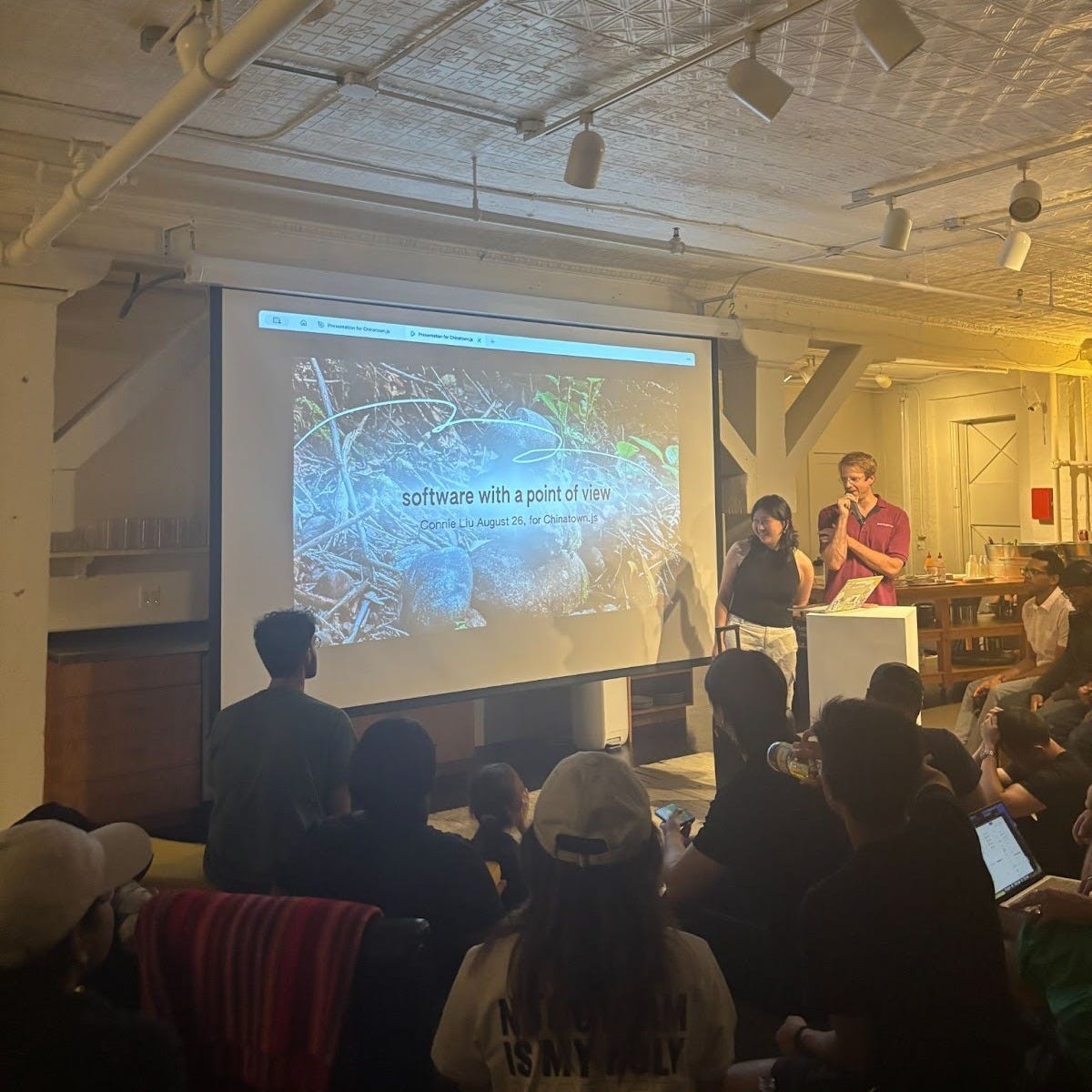
Connie Liu is an internet surfer who makes websites to propose alternative futures.
What is inprogress.works?
Inprogress.works is a lightweight accountability community and journal for your side projects. Each week you’ll get an email reminder to post your WIP update and get to see your progress through an archive. Creating and making things is important because I believe it’s the surest path to self actualization and engaging with the world. The key aspect that makes it different from other social networks is that you cannot see anyone else’s update post until you post yourself.
Why is making things good for self-actualization?
Creating is an act of friction, it’s not easy to do. To create you have to take all your existing thoughts, connect the dots, and tell a story. Sometimes your thoughts are about yourself and how you feel, other times it’s about what is happening in the world around you and what you think about the way things should be. You’re not just thinking about whether you’ll understand it but if others will too - you have to keep on making choices. Those very choices are based on what draws your attention and who you are. That’s different from when you’re consuming media and are essentially taking in someone else’s thoughts and what they care about. Making choices is an act of self-actualization.
Tell me about why it is important to track your progress with others…
Growing up in a small town, I didn’t think it was possible to practice technology as art until I went online and found the work of so many I admire. I wanted inprogress.works to be a way for people to find each other through a shared joy of making.
Before the algorithm, social media feeds were largely for connecting with your friends. You would see what your friends posted in chronological order and there was an end to the feed. If you wanted to view something related to your interest, you would search it up. Now there isn’t even that option anymore to see a chronological following feed on Instagram, within a scroll you’ll see an ad or suggested post. Maybe in a few you can catch up on what other people have posted.
Even worse is people changing how and what they post specifically for the algorithm and capturing attention. Creating becomes more about metrics - posting dependent on what will drive likes and what will grow followers - than about connection. In that vein, going on social media very much feels like watching television - you are watching the world but you aren’t interacting with it. I wanted to discourage one-way social feeds that are optimized towards the algorithm and monetizing influence. I wanted to create social media where there is mutual participation and posting is incentivized purely for the act itself rather than chasing this game of metrics. I believe the power of social media is in finding each other and that’s how we can stay grounded in the real world and ourselves.
Who or what inspired you?
I’m inspired by special.fish, a small social network/community word processor, it first introduced me to the idea of an alternative way to connect away from the increasingly enshittified platforms today. Beyond that, Retro and Bereal for its focus on documenting life in the moment, Strava for activity-based social media, and of course Are.na which showed me what happens when you build software from your principles. I recommend everyone to start going to Are.na meetups, Wikipedia Jams, and other places where you can meet others who believe in the potential for technology to be more than what we have today - to awaken the human spirit rather than diminish it.
Join inprogress.works and see what happens when you commit to something for a year. You can also leave a note for Connie.
‧₊˚♪ 𝄞₊˚⊹
Field notes
1.
How To Start a Permacomputing Collective. The people behind a handful of the active permacomputing groups share notes on how to get started with your local initiative. Permacomputing is an example of actual solarpunk.
2.
Actually Existing Solarpunk. James Bridle writes about the existing possibilities, given that the price of solar panels is just twice that of a wooden fencing sheet of the same size.
3.
Taper #15 : Crossroads. Congratulations to the team behind Taper on the latest edition of their computational poetry journal.
4.
Call for Participation. SFPC Spring 2026 (Due, Feb 9), Parameter (Due, Feb 10), t*issues publishing (Due, Feb 12), Everyoneisagirl (Due, Feb 14), Needlebound (Due, Feb 15), re•mediate (Due, N/A), NMWP Annual Unconference (Due, Feb 28), Solar Futures (Due, Mar 15), Cursor Mag (Due, Mar 15), Permeable Barrier (Due, Mar 22), and IndieCon Travel Grant (Due, N/A).
5.
Poetic Web Calendar. être script (Feb 10, Paris), Permacomputing and Programming (Feb 10, NYC), Pop Up Internet Cafe (Feb 14, SF), Literary Manuals Coding Workshop (Feb 15, London), Teaching Creative Technology (Feb 17, NYC), Cybernetics Library (Feb 21, NYC), Internet Infrastructure Walking Tour (Mar 8, London), The Web You Want (Apr 17, Amsterdam), and Open Hardware Summit (May 23-24, Berlin).
. ݁₊ ⊹ . ݁ ⟡ ݁ . ⊹ ₊ ݁.
Wayside flowers

Want more? Read last week’s email. You can send questions, comments, products, sites, links, and more to kristoffer@naiveweekly.com.